
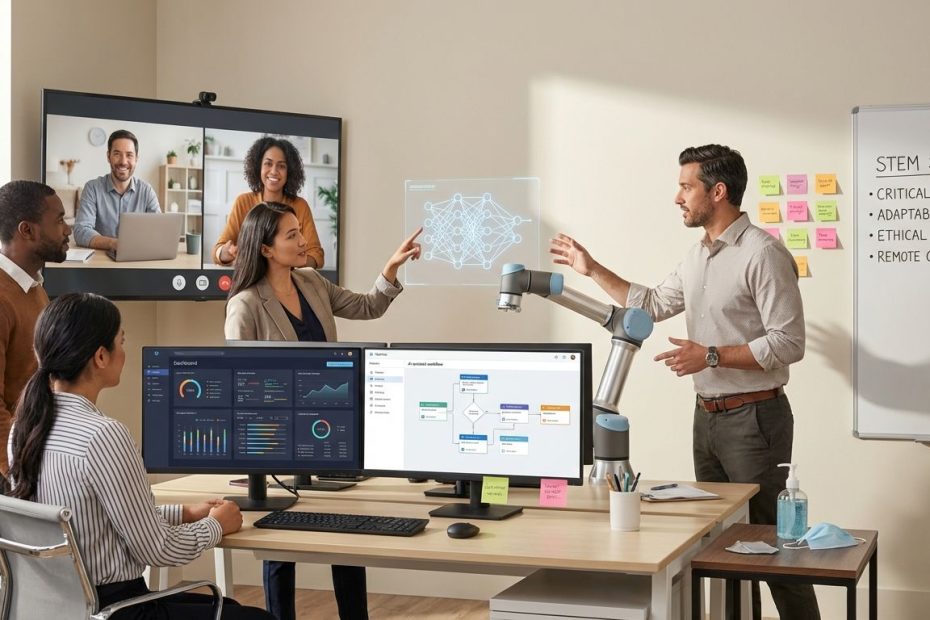
You stay competitive in STEM by combining strong technical fundamentals, AI fluency you can verify, and dependable execution skills that hold up in distributed teams and fast-changing toolchains.
This guide gives you a practical skills map you can act on immediately: what employers signal they need, what working professionals say actually gets hired, how to build proof fast, and how to choose a learning order that matches real workflows. You leave with a clear plan for what to learn, how to practice it, and how to present it without sounding like a buzzword résumé.
What Skills Do Employers Want Most For STEM Jobs In 2025–2030?
Employers keep rewarding the same core abilities, even as tools rotate every year: analytical thinking, adaptability under change, and the ability to lead and collaborate through ambiguity. The reason is operational, not philosophical. Teams ship work across time zones, automate routine tasks, and expect you to turn incomplete inputs into defensible decisions.
The World Economic Forum’s Future of Jobs findings put analytical thinking, resilience, flexibility, agility, and leadership and social influence among the most-cited core skills by employers, with technology skills like AI and big data, cybersecurity, and broad technological literacy rising fast. That combination tells you what to do with your time: build technical leverage, then prove you can apply it with good judgment and reliable follow-through.
In practical terms, this means your value is measured by outcomes, not activity. Can you diagnose a problem, choose a method, validate results, and communicate tradeoffs without drama. Can you protect data, keep systems stable, and document decisions so someone else can maintain your work. These are the behaviors managers promote, and these are the behaviors that survive hiring slowdowns.
Do You Really Need AI Skills For A STEM Career Now And What Counts As “AI Skills”?
AI is now part of normal STEM workflows, which means baseline AI fluency is becoming a default expectation, not a specialty. Stack Overflow’s developer survey reports that 84% of respondents are using or planning to use AI tools in their development process. That number matters because it reflects daily habits, not aspirational strategy decks.
“AI skills” rarely means building a model from scratch. For most roles, it means using AI tools to accelerate research, code, analysis, documentation, testing, and troubleshooting while keeping quality and safety intact. You earn trust by showing that AI output does not bypass your engineering standards. You treat AI as a fast draft engine, then you validate with tests, constraints, references, and reviews.
Trust is the dividing line. Reporting tied to the same survey highlights that many developers still distrust AI accuracy and spend time debugging AI-generated code. That reality reshapes what “good” looks like: prompt craft matters, but verification matters more. You stand out when you can say, in plain language, how you checked the output, where it failed, what guardrails you set, and what you changed to make it production-safe.
Operational AI fluency also includes knowing when not to use it. Sensitive data, proprietary code, regulated environments, and high-risk decisions demand tighter controls. You get career momentum by showing you can use AI responsibly inside real constraints, not by claiming you “use AI for everything.” Hiring managers have already heard that line.
What Are The Most Future-Proof Technical Skills For STEM Grads Besides Coding?
Future-proof in STEM means portable across industries and resilient to tool churn. Data literacy sits near the top because every domain now runs on measurement: experiments, telemetry, logs, patient outcomes, manufacturing yields, financial risk, environmental monitoring. If you can turn raw data into a reliable decision, you remain valuable in any vertical.
Start with SQL and the ability to reason about data structures, joins, missingness, sampling, and bias. Add statistics that you can apply, not recite: distributions, uncertainty, hypothesis tests, regression basics, and the ability to interpret metrics without fooling yourself. Pair that with version control, reproducible workflows, and documentation habits that let a teammate rerun your work without a meeting.
Cloud fundamentals are also durable because workloads keep moving to managed platforms. You do not need to memorize every vendor product. You do need to understand core primitives: identity and access, storage types, networking basics, compute options, monitoring, and cost awareness. If you can explain why a system is slow, expensive, or fragile, you can contribute in software, data, research computing, or applied engineering.
Security-aware thinking is the multiplier skill most early-career candidates ignore. You do not need to be a security specialist to protect secrets, enforce least privilege, handle data safely, and avoid shipping obvious vulnerabilities. Managers remember the person who prevented an incident more than the person who wrote an elegant script.
What Soft Skills Matter Most For STEM Careers In A Distributed Workplace?
Soft skills in STEM are execution skills. They show up as fewer rework cycles, faster alignment, cleaner handoffs, and better incident response. Employers keep ranking analytical thinking and adaptability high because technical work is rarely clean. Requirements shift, data breaks, dependencies change, and the person who stays effective under that pressure becomes the stabilizer everyone wants on the team.
Communication is not “being friendly.” It is writing a clear problem statement, defining success metrics, documenting assumptions, and summarizing decisions so others can move without asking you to repeat yourself. In distributed teams, writing becomes a core engineering tool. A strong design note, a crisp pull request description, or a well-structured experiment report can save days of churn.
Collaboration and leadership show up early in small ways: how you review code, how you surface risks, how you ask for help with enough detail to be answerable, how you disagree without stalling delivery. These behaviors signal maturity. Tools can be taught. Judgment and teamwork patterns take longer, so hiring managers watch for them.
Resilience and adaptability are also visible. They look like steady output, not heroics. They look like planning work, managing scope, and keeping quality standards when timelines tighten. If you can do that consistently, you become the person managers trust with higher-impact projects.
Which Skills Help You Stand Out When Entry-Level Roles Feel Harder To Get?
You stand out by proving you can deliver, not by listing more tools. Entry-level job posts often contain long wish lists that reflect multiple roles blended into one template. Hiring decisions usually come down to whether you can take a real problem, execute a reasonable plan, and communicate the result like a professional.
Portfolios work when they show constraints and tradeoffs, not when they look like a tutorial clone. A strong project demonstrates a complete arc: problem definition, data acquisition, cleaning, validation, analysis or modeling, deployment or packaging, monitoring, and a short write-up with limitations. That write-up matters because it shows you understand quality, risk, and what remains unknown.
AI has increased claim inflation. Some job-market reporting shows job seekers exaggerate AI competency, which makes credibility a differentiator. You win by being specific: what AI tool you used, what you used it for, what failed, how you verified outputs, what tests you added, what metrics improved, and what you would do differently. That level of detail reads like real work because it is real work.
Another differentiator is operational readiness. You can show that with clean Git history, issues tracked in a simple board, reproducible environments, and a README that lets a reviewer run your work in minutes. Most applicants never reach that bar. Reaching it signals you will not be a drain on your team.
What Should You Learn First Python, SQL, Cloud, Cybersecurity, Or DevOps?
The best learning order matches how work actually flows. Most STEM roles touch data, automation, and systems, even when the title is not “developer.” A practical default sequence is SQL and data fundamentals, Python for automation and analysis, then one cloud platform’s basics, then security and delivery practices that keep your work safe and maintainable.
SQL earns its spot because it forces you to think in sets, constraints, and correctness. It also shows up everywhere: analytics, experiments, monitoring, and operational troubleshooting. Python follows because it is the glue language for analysis, scripting, testing, and basic services. If you can combine SQL and Python, you can contribute in research, engineering, product analytics, biotech, finance, and manufacturing.
Cloud comes next because modern environments expect you to run work reliably. Learn identity and access management concepts, basic networking, storage choices, and how logging and monitoring work. Then add one execution path: a container, a scheduled job, a simple API, or a data pipeline. That experience teaches you practical reliability and cost awareness, which employers value more than vendor trivia.
Security and DevOps concepts should not wait until “later.” Build them into your habits early: secrets management, least privilege, dependency hygiene, testing, and basic CI. You do not need to become an SRE. You do need to avoid shipping fragile work that breaks when someone else touches it.
Essential Skills For STEM Careers
- Analytical thinking, adaptability, and communication
- AI fluency plus verification, testing, debugging
- Data literacy, SQL, Python, cloud basics, security mindset
Turn These Skills Into A 90-Day Execution Plan
Pick one role target and build one proof artifact that looks like the job. If the target is data, ship a pipeline and a dashboard with documented assumptions and validation checks. If the target is software, ship a small service with tests, logging, and a deployment recipe. If the target is research computing, ship a reproducible notebook package with data versioning and clear evaluation notes.
Use AI tools as accelerators, then prove you stayed in control: keep prompts and decisions in notes, add tests, link evidence, and document what you verified manually. When a hiring manager asks about AI usage, answer with process, not hype. State how you reduced risk and improved delivery speed without lowering quality.
Keep your learning tight and measurable. Track weekly outputs: one finished feature, one bug fixed with a postmortem note, one performance improvement with a before-and-after metric, one write-up that a stranger can follow. You build confidence by shipping. Hiring managers build confidence by reviewing what you shipped.
Build Your Next Career Step With Proof, Not Buzzwords
STEM careers reward people who combine technical ability with disciplined execution, clear communication, and sound judgment under pressure. Employers keep signaling demand for analytical thinking and adaptability, and the market is also normalizing AI-assisted workflows, which raises the bar on verification and quality control. If you anchor your skill-building in data literacy, Python, SQL, cloud fundamentals, and a security-aware mindset, you stay portable across industries. Pair that with a portfolio that demonstrates end-to-end delivery and you stop competing on keyword lists. Commit to one focused plan, ship artifacts that mirror real work, and present your results with crisp writing and measured claims.
References
- World Economic Forum: The Future of Jobs Report 2025 (PDF) – https://www3.weforum.org/docs/WEF_Future_of_Jobs_Report_2025.pdf
- World Economic Forum: Future of Jobs Report 2025 Digest – https://www.weforum.org/publications/the-future-of-jobs-report-2025/digest/
- Stack Overflow: 2025 Developer Survey (AI) – https://survey.stackoverflow.co/2025/ai
- ITPro: 84% of software developers are now using AI, but nearly half don’t trust accuracy – https://www.itpro.com/software/development/developers-arent-quite-ready-to-place-their-trust-in-ai-nearly-half-say-they-dont-trust-the-accuracy-of-outputs-and-end-up-wasting-time-debugging-code
- Axios: The dimming job market’s bright spot: AI skills – https://www.axios.com/2025/11/09/job-market-ai-skills
- Reddit: “What was your stack, tools, languages or frameworks you knew when you got your first job?” – https://www.reddit.com/r/DataScienceJobs/comments/1norvdf/
- Reddit: “What do I do now?” – https://www.reddit.com/r/cscareerquestions/comments/1in10vq/
- Reddit: Weekly Entering & Transitioning Thread – https://www.reddit.com/r/datascience/comments/1nhbvwg/

Jay Holstine is a Vistage Chair and veteran tech CEO with 20+ years of experience in SaaS and operations. The founder of SigmaFlow and former CEO of Freightflow, he now leads a Dallas–Fort Worth CEO peer group and advises executives on strategy, process improvement, and scalable growth.