
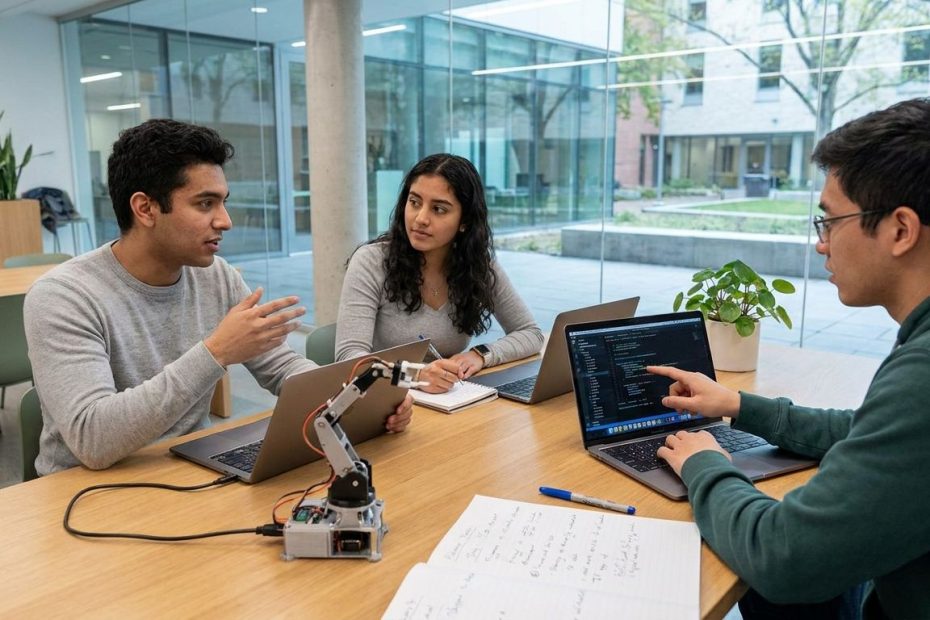
Soft skills are critical for Science, Technology, Engineering, and Mathematics (STEM) students because technical knowledge only creates value when you can communicate it, test it with others, and apply it under real workplace pressure. If you want internships, stronger project results, and faster career growth, you need to build human skills with the same discipline you apply to coding, lab work, design, mathematics, and research.
You’ll see why employers now rank communication, teamwork, problem-solving, adaptability, and leadership beside technical ability, not beneath it. You’ll also learn how to turn class projects, labs, capstones, interviews, and early job experiences into proof that you can work well with people, not just tools.
What Are Soft Skills In STEM?
Soft skills in STEM are the workplace abilities that help you use technical knowledge with people, teams, constraints, deadlines, and decisions. They include written communication, verbal communication, teamwork, active listening, problem-solving, adaptability, leadership, ethical judgment, time management, feedback handling, and professional behavior.
These skills don’t replace technical skill. They make technical skill usable. A brilliant analysis, design, model, prototype, or research finding has limited value if you can’t explain what it means, why it matters, what assumptions sit behind it, and what decision should follow.
In a STEM program, you may first notice soft skills during group labs, peer reviews, research meetings, coding sprints, engineering design projects, presentations, and internships. Those moments are not side activities. They mirror the way STEM work gets done inside companies, laboratories, hospitals, manufacturing teams, energy groups, product teams, universities, and public agencies.
The phrase “soft skills” can sound weak, which is part of the problem. These skills are often hard to practice because they require judgment, timing, self-control, clarity, and adjustment to different audiences. A student who can explain a technical tradeoff to a professor, a teammate, a recruiter, and a nontechnical manager has a career advantage that doesn’t show up in a single test score.
You should treat soft skills as observable behavior, not personality. You don’t need to become loud, polished, or overly social to show strength in this area. You need to prepare well, listen carefully, ask direct questions, document decisions, speak with purpose, and help a team move work forward.
Why Are Soft Skills Important For STEM Students?
Soft skills matter because most STEM work is shared work. You rarely solve meaningful technical problems alone from start to finish, especially after graduation. You inherit requirements, review data from others, depend on teammates, explain results to decision-makers, and adjust your work when priorities change.
Employers look for proof that you can operate in that environment. The National Association of Colleges and Employers reports that employers look for problem-solving, teamwork, and written communication at the top of new-graduate résumé attributes, with technical skills appearing alongside those human-centered abilities. That should get your attention if your résumé is filled only with software names, lab methods, equations, and tools.
For a STEM student, the practical message is simple: technical depth gets you considered, and soft skills help you get trusted. Trust determines who gets invited into meetings, who gets assigned visible work, who gets a strong internship review, and who becomes the person others rely on when the work gets messy.
You also need soft skills because STEM problems are rarely tidy. A data scientist must explain uncertainty, an engineer must describe tradeoffs, a cybersecurity analyst must communicate risk, a researcher must defend a method, and a software developer must clarify requirements before writing code. If your explanation creates confusion, your technical work slows down.
This is where many students misread the job market. They assume employers want the person with the longest list of technical tools. Employers do value tools, but they also need graduates who can learn new tools, work inside teams, respond to feedback, and communicate progress before a deadline slips.
Soft skills also protect your technical work from being misunderstood. If you can document your assumptions, clarify decisions, and explain why a result changed, you reduce rework. That’s not “being nice.” That’s operational competence.
Which Soft Skills Do Employers Want From STEM Graduates?
Employers want STEM graduates who can solve problems, communicate clearly, work in teams, adapt, think critically, show initiative, and act professionally. You don’t need to master every workplace skill before your first job, but you do need evidence that you’re building them on purpose.
Problem-solving sits at the center because STEM work starts with ambiguity. You often receive incomplete information, conflicting goals, limited time, or unclear requirements. Strong problem-solvers define the issue, identify constraints, test options, and explain why one path makes more sense than another.
Communication comes close behind because every technical decision needs translation. Your professor may understand the math, but your internship supervisor may care about risk, cost, time, accuracy, or user impact. Your ability to adjust your explanation to the audience can separate you from classmates with similar grades.
Teamwork matters because modern STEM work combines specialties. A robotics project may require mechanical design, electrical systems, embedded software, testing, budgeting, documentation, and presentation. The project suffers when one student disappears, withholds information, ignores feedback, or finishes their part without checking integration needs.
Adaptability matters because tools, requirements, research findings, and job duties shift. A student who can learn a new programming library, revise a design after test failure, or change a presentation after new data arrives brings stability to a team. Adaptability doesn’t mean accepting chaos; it means staying effective when the plan changes.
Leadership matters earlier than many students expect. You don’t need a title to lead. You can set up the meeting agenda, clarify ownership, summarize decisions, notice a blocked teammate, or volunteer to present the team’s work when nobody else steps up.
Ethical judgment matters because STEM decisions affect budgets, safety, privacy, reliability, access, and public trust. You may work with data, structures, medical devices, artificial intelligence systems, energy equipment, or security tools. Employers need graduates who can recognize risks, raise concerns, and avoid cutting corners when pressure rises.
Active listening deserves more respect than it gets. Many early-career errors come from answering the wrong question, solving the wrong problem, or missing a constraint that someone already stated. If you listen well, repeat back requirements, and ask for clarification, you prevent avoidable mistakes.
Are Soft Skills More Important Than Technical Skills In STEM?
Soft skills are not more important than technical skills in every STEM role, but they become just as important once you reach baseline competence. You still need the math, science, engineering methods, coding ability, laboratory skill, design knowledge, data fluency, or domain expertise required for the work.
The real issue is employability and growth. Once several candidates can meet the technical bar, employers compare how each person communicates, learns, collaborates, handles pressure, and explains decisions. That’s where soft skills start changing outcomes.
Think about a technical interview. You may solve the problem, but the interviewer also watches how you reason out loud, respond to hints, recover from mistakes, and clarify assumptions. The answer matters, but your working style tells the employer what you’ll be like on a team.
The same pattern appears in internships. You may complete assigned work, but your manager also notices whether you ask useful questions, document progress, flag blockers early, and accept feedback without defensiveness. Internships often become job offers when technical work and workplace behavior line up.
Soft skills also affect how quickly others can benefit from your technical work. A student who writes clean documentation, explains design choices, and shares progress saves time for everyone around them. A student who produces good work in silence may still create risk if nobody knows what was done, why it was done, or how to maintain it.
You don’t need to choose between technical strength and soft skills. Build them together. Present your technical project, write a short project brief, lead a review meeting, ask for critique, revise your work, and track what changed.
This combined skill set becomes valuable as your career advances. Entry-level roles may reward task completion. Senior roles reward judgment, coordination, mentoring, decision-making, and communication across groups.
How Do Soft Skills Help STEM Students Get Internships And Jobs?
Soft skills help you get internships and jobs because hiring is a communication process. Your résumé, portfolio, interview answers, career fair conversations, emails, referrals, and follow-ups all depend on your ability to explain your value clearly.
A résumé that only says “built a machine learning model” leaves too much work for the recruiter. A stronger version says you built the model, explained the assumptions, documented limitations, presented findings to a team, and revised the output after feedback. That sentence shows technical skill and workplace readiness at the same time.
During interviews, employers listen for evidence that you can join a team without creating extra confusion. They want to know how you handle disagreement, deadlines, incomplete information, and mistakes. A strong answer describes what you did, how you communicated, what changed, and what the outcome was.
Career fairs also reward soft skills. You may have less than two minutes to introduce yourself, name your area of interest, mention one relevant project, and ask a useful question. Students who prepare concise introductions often stand out more than students with stronger technical backgrounds but unclear delivery.
Soft skills also improve referrals. Classmates, professors, lab supervisors, teaching assistants, and internship mentors are more likely to recommend you when you’re dependable, responsive, prepared, and easy to work with. Your reputation starts before your first full-time role.
Written communication carries a lot of weight in early hiring. Recruiters and managers read emails, project descriptions, GitHub repository notes, lab summaries, design reports, and portfolio pages. If your writing is precise and organized, your technical work feels easier to trust.
You can also show soft skills through how you describe failure. A mature student can say what went wrong, what was learned, what was changed, and how the team improved. That kind of answer signals readiness because real STEM work includes failed tests, unclear data, broken builds, missed assumptions, and revisions.
How Do Soft Skills Improve Teamwork In STEM Projects?
Soft skills improve teamwork by making coordination visible. In STEM projects, the work often breaks down across tasks, tools, deadlines, dependencies, and review points. If communication breaks down, the project becomes slower, riskier, and harder to repair.
Good teamwork starts with clear ownership. You should know who is responsible for research, data cleaning, design, testing, documentation, presentation, quality checks, and final submission. When ownership is vague, teams waste time guessing who handled what.
Strong communication also prevents integration problems. A software module may work alone but fail when connected to another part of the system. A lab result may look useful until the team realizes the method changed halfway through data collection.
Active listening helps teams catch these issues early. When a teammate raises a concern, don’t rush to defend your work. Ask what they’re seeing, check the evidence, and decide what needs to change.
Conflict management also matters. STEM teams often disagree about methods, scope, accuracy, timelines, or design choices. Productive disagreement focuses on evidence, constraints, and goals instead of personal preference.
Documentation is one of the most underrated soft skills in STEM teamwork. Meeting notes, decision logs, test results, code comments, design records, and change summaries help the team remember why decisions were made. They also make it easier for professors, managers, or future teammates to review the work.
Feedback habits can raise or lower the quality of a project. You should give feedback that is specific, timely, and tied to the objective. You should receive feedback by asking clarifying questions, making the needed change, and confirming whether the update solves the concern.
ABET, the engineering accreditation organization, includes communication, ethical responsibility, teamwork, leadership, goal setting, task planning, and meeting objectives in its expected student outcomes for engineering programs. That sends a direct signal: the education standard for engineers already treats these abilities as part of professional readiness.
Why Do Soft Skills Matter More As Artificial Intelligence Changes STEM Work?
Artificial intelligence (AI) is changing the way STEM students learn, build, analyze, write, test, and troubleshoot. Tools can now generate code drafts, summarize papers, create design options, review data patterns, and support technical research. That raises the bar for your judgment.
When tools can produce quick outputs, employers need people who can evaluate those outputs. You need to ask whether the answer is accurate, whether the data is appropriate, whether the assumptions are valid, whether the risk is acceptable, and whether the result can be explained to another person.
Soft skills become more valuable because AI-supported work still needs human coordination. Someone must define the problem, decide what good looks like, communicate uncertainty, handle objections, and explain tradeoffs. A tool can assist a task, but it doesn’t replace accountability for the decision.
The World Economic Forum reports that analytical thinking remains a top core skill, with resilience, flexibility, agility, leadership, and social influence also ranking near the top for employers. That mix tells you where the labor market is heading: technical fluency matters, and the human skills around it matter just as much.
AI also increases the need for clear writing. Prompts, documentation, review notes, model explanations, test plans, and change logs all depend on language. If you write vague instructions, you get vague results, and vague results create risk.
Communication becomes a safety check. If you can explain how an AI-assisted result was created, what was verified, what remains uncertain, and where human review happened, you build confidence. If you can’t explain it, the work may be fast but fragile.
Adaptability also becomes a career asset. Tools will change, workflows will change, and expectations will change. You need the learning habits to keep up without losing your standards for accuracy, teamwork, and professional judgment.
Can STEM Students Learn Soft Skills, Or Are They Natural Traits?
You can learn soft skills. They are not fixed traits reserved for outgoing students, natural speakers, or people who enjoy group work. They improve through practice, feedback, reflection, and repeated use inside real technical tasks.
Start with communication. After every project, write a short summary of the objective, method, result, limitation, and recommended action. If you can explain your work in five sentences, you understand it better and present it better.
Build teamwork by becoming dependable in small ways. Show up prepared, meet your deadlines, ask what others need from you, and share updates before someone has to chase you. Reliability is one of the fastest ways to earn trust.
Build active listening during class, lab, and internship work. When someone gives a requirement, repeat it back in plain language. Ask, “What does success look like?” or “Which constraint matters most?” Those questions prevent you from spending hours on the wrong problem.
Build adaptability by reflecting after setbacks. When a test fails, code breaks, a model performs poorly, or a design gets rejected, write down what changed and what you’ll adjust. This turns frustration into usable learning.
Build leadership by taking responsibility for process, not control. You can create the project timeline, organize the file structure, summarize meetings, or help the team decide what to finish first. Good student leadership often looks quiet and practical.
Build presentation skill through repetition. Present your work to classmates, mentors, professors, student clubs, or internship teams. Record yourself once in a while, listen for unclear wording, and cut anything that doesn’t help the audience understand the decision.
Build professional writing through artifacts. Keep a portfolio with project summaries, design notes, research posters, code documentation, lab reflections, and presentation slides. Your future interviewer should be able to see how you think, not just what tools you used.
What Should STEM Students Do Now To Build Career-Ready Soft Skills?
Start by choosing three soft skills to improve this semester: communication, teamwork, and adaptability are a strong set. Don’t turn this into a vague personal goal. Attach each skill to a behavior you can measure.
For communication, commit to writing a short project summary after every major assignment. Include the problem, your role, the method, the result, and what you would improve. This gives you ready material for interviews, résumés, portfolios, and networking conversations.
For teamwork, ask your group to define roles early. Decide who handles research, build work, data, testing, writing, presentation, and final review. Write the plan down, because spoken agreements are easy to forget under deadline pressure.
For adaptability, keep a decision log. Note when assumptions changed, when feedback arrived, when a test failed, and what you adjusted. This makes your learning visible and gives you stronger answers for behavioral interview questions.
You should also practice explaining technical work to different audiences. Explain one project to a classmate in your major, then to someone outside your major, then to a mentor or recruiter. Each version should be accurate, but the level of detail should change.
Join environments where soft skills are required, not optional. Research teams, student engineering groups, hackathons, mathematics competitions, robotics teams, tutoring roles, peer mentoring, laboratory assistant roles, and internships all create practical pressure. You don’t build these skills by reading about them alone.
Ask for direct feedback. After a presentation, ask what was clear and what was confusing. After a team project, ask whether your communication helped the group move faster. Feedback may sting a little, but it saves you from repeating habits that limit your growth.
Update your résumé so soft skills appear through evidence, not claims. Instead of listing “team player,” describe the team size, your role, the technical task, the communication task, and the outcome. Recruiters trust proof more than labels.
Use office hours and mentoring conversations as practice. Explain where you’re stuck, what you’ve already tried, and what decision you need help making. That habit will serve you later when you brief a manager, research lead, client, or cross-functional team.
Pay attention to your digital communication. Clear subject lines, concise messages, respectful follow-ups, and organized shared files create a professional signal. You may think these details are small, but early-career trust is built through small signals repeated over time.
Why Are Soft Skills Critical For STEM Students?
- They help you explain technical work.
- They improve teamwork and trust.
- They strengthen interviews and internships.
- They prepare you for AI-shaped work.
Build The Human Skills That Make Your Technical Skills Count
Your STEM knowledge gives you the foundation, but your soft skills determine how well that knowledge travels through teams, interviews, projects, and workplace decisions. If you can communicate clearly, collaborate well, adapt under pressure, and explain technical tradeoffs, you become easier to hire, easier to trust, and easier to promote. Start with small daily habits: write cleaner summaries, ask better questions, document decisions, present your work, and seek direct feedback. The students who win over time are not just the ones who know the material; they’re the ones who can turn knowledge into shared results. Build that ability now, and your technical talent will carry much farther.
References
- National Association of Colleges and Employers, Job Outlook 2025.
- United States Bureau of Labor Statistics, STEM Employment Projections.
- United States Bureau of Labor Statistics, STEM Occupations Poster.
- ABET, Criteria For Accrediting Engineering Programs.
- World Economic Forum, The Future Of Jobs Report 2025.
- Frontiers In Education, STEM-Based Approaches To Soft Skills Development.
- American Association Of Colleges And Universities Employer Survey Release.
- McKinsey Global Institute, Work Partnerships Between People, Agents, And Robots.
- Pew Research Center, Workers’ Views Of Artificial Intelligence Use In The Workplace.

Jay Holstine is a Vistage Chair and veteran tech CEO with 20+ years of experience in SaaS and operations. The founder of SigmaFlow and former CEO of Freightflow, he now leads a Dallas–Fort Worth CEO peer group and advises executives on strategy, process improvement, and scalable growth.