
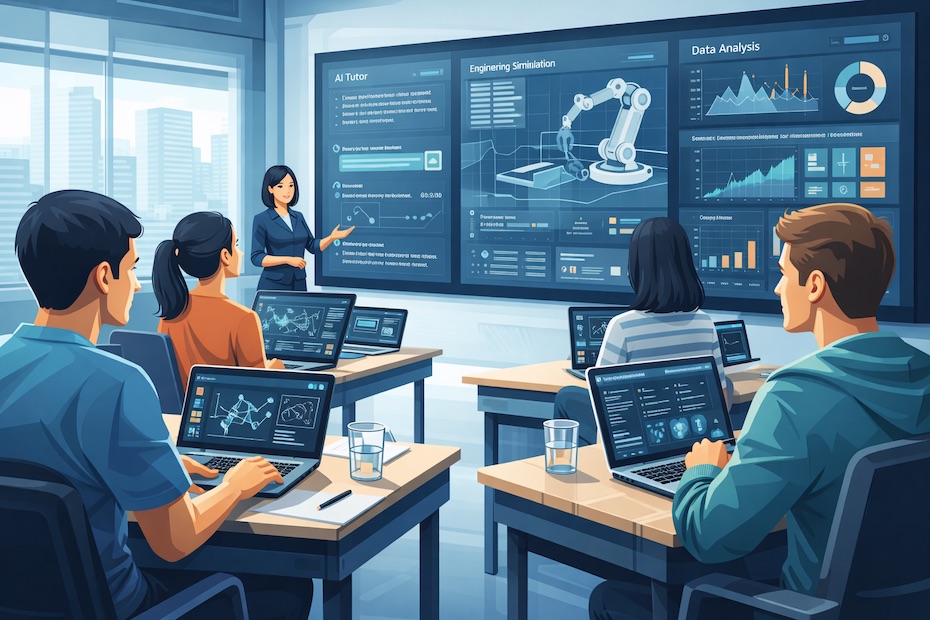
AI is redefining STEM education by shifting learning away from static content and toward continuous experimentation, adaptive feedback, and applied problem-solving. This shift equips students to think and build at the speed modern science and engineering now require.
This article explains how AI is changing how STEM students learn, practice, and innovate. You will see how intelligent systems improve skill development, where they outperform traditional methods, and why tomorrow’s innovators will look very different from those trained only through textbooks.
What does AI-driven STEM learning actually mean today?
AI-driven STEM learning means students interact with systems that respond to how they think, not just what they answer. Instruction adapts continuously based on performance patterns, reasoning steps, and learning pace.
Instead of moving through fixed chapters, students progress through personalized learning paths. A student struggling with vector math receives targeted reinforcement. A student advancing quickly moves into applied challenges sooner.
Real-time education research shows that adaptive learning systems increase engagement and comprehension in complex STEM subjects by responding to cognitive gaps before they compound.
Why are textbooks no longer sufficient for modern STEM education?
Textbooks present knowledge as settled and linear. STEM work rarely unfolds that way.
In engineering, data science, and applied research, problems remain incomplete. Variables shift. Constraints change. Textbooks cannot replicate this environment.
AI introduces variability, iteration, and feedback into learning. Students practice testing assumptions, adjusting models, and correcting errors rather than memorizing final answers. This mirrors how innovation actually happens.
How does AI personalize learning for STEM students?
AI personalization focuses on reasoning patterns rather than surface accuracy.
Systems analyze how students approach problems, how long they spend on each step, and where errors occur. Instruction then targets specific misunderstandings instead of repeating entire lessons.
This matters deeply in STEM, where small conceptual gaps can derail progress. Early, precise correction builds confidence and supports long-term mastery.
Can AI improve problem-solving skills rather than encourage shortcuts?
Yes, when designed correctly, AI strengthens reasoning instead of bypassing it.
Effective systems prompt students to explain their steps, test alternate approaches, and validate outputs. Feedback focuses on method quality, not just results.
This reflects professional STEM practice, where tools assist analysis but accountability remains human. Students trained this way learn to collaborate with intelligent systems rather than defer to them.
How is AI reshaping hands-on STEM experimentation?
AI expands access to experimentation beyond physical laboratories.
Simulation platforms allow students to test variables repeatedly without material limits. Intelligent analysis tools help interpret outcomes quickly and accurately.
Students gain experience in hypothesis testing, experimental design, and data interpretation even when physical resources are limited. This widens access to advanced STEM practice.
What role does AI play in coding and computational thinking?
AI supports coding education by shifting focus from syntax memorization to logical structure and efficiency.
Students explore algorithm design, debugging strategies, and performance optimization. Systems flag inefficiencies and logical errors without completing work for the learner.
This approach builds transferable computational thinking skills used across engineering, analytics, and research roles.
Does AI reduce the role of teachers in STEM classrooms?
AI changes teaching roles without diminishing their importance.
Educators move from constant instruction to targeted coaching and mentorship. AI handles routine assessment and differentiation. Teachers focus on guiding inquiry and applying judgment.
This redistribution of effort allows deeper engagement with students and improves instructional quality rather than replacing human expertise.
How does AI prepare students for real-world STEM careers?
Modern STEM careers require constant interaction with intelligent tools.
AI-enhanced education reflects this reality. Students learn to validate outputs, question assumptions, and integrate machine analysis into decisions.
Graduates enter the workforce with experience in human-AI collaboration, a skill increasingly expected across technical disciplines.
What concerns do students and educators raise about AI in STEM?
Common concerns include over-dependence, academic integrity, and unequal access.
Effective programs address these through clear usage boundaries, transparent system behavior, and process-based evaluation. Students demonstrate understanding through explanation and reasoning, not just answers.
When guided properly, AI strengthens discipline rather than weakening it.
How should institutions measure success in AI-supported STEM learning?
Success metrics must shift from completion to capability.
Key indicators include reasoning depth, adaptability, problem-solving progression, and collaboration quality. AI systems generate detailed learning data to support these evaluations.
Institutions that align assessment with capability gain clearer insight into readiness for advanced study and innovation-driven careers.
Why does AI broaden the definition of a STEM innovator?
Innovation now depends less on memorized knowledge and more on adaptive thinking.
AI-supported learning rewards experimentation, persistence, and cross-disciplinary reasoning. Students from diverse backgrounds access advanced practice earlier.
This broadens participation and produces innovators who think across domains rather than inside silos.
How is AI changing STEM education?
- Personalized learning paths
- Continuous feedback on reasoning
- Expanded access to experimentation
- Preparation for human-AI collaboration
Train Students for the Problems That Do Not Exist Yet
STEM education no longer succeeds by delivering finished answers. It succeeds by training minds that adapt under uncertainty. AI accelerates this shift by embedding feedback, iteration, and experimentation into daily learning. Students trained beyond the textbook learn how to reason, test, and refine ideas continuously. The next generation of STEM innovators will emerge from classrooms that treat intelligence as interactive rather than static.
If you want to explore more writing on education, innovation, and how technology reshapes learning outcomes, visit my linkedin to read additional posts on future-ready skills and academic transformation.

Jay Holstine is a Vistage Chair and veteran tech CEO with 20+ years of experience in SaaS and operations. The founder of SigmaFlow and former CEO of Freightflow, he now leads a Dallas–Fort Worth CEO peer group and advises executives on strategy, process improvement, and scalable growth.