
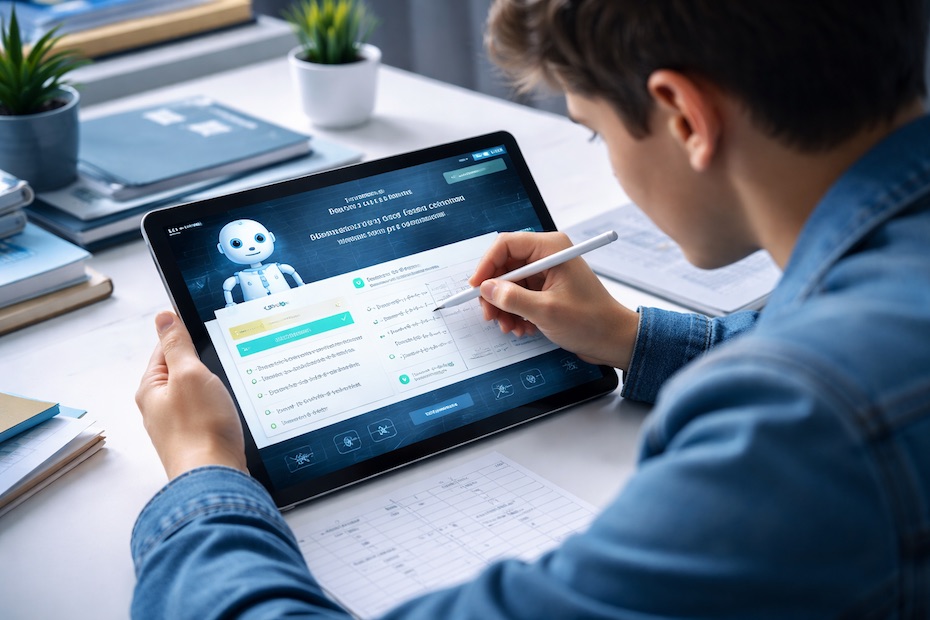
The AI tutor is already changing how you master STEM by delivering personalized instruction, instant feedback, and adaptive practice aligned to your exact learning needs. When used correctly, AI tutoring shortens learning curves, reduces frustration, and builds real subject mastery instead of surface-level progress.
This article shows how personalized AI tutors work in real STEM learning environments, what learners are actively asking about them, and how you can use them strategically to master math, science, engineering, and technology subjects with measurable results.
What Is an AI Tutor and How Does It Support STEM Learning?
An AI tutor is an intelligent learning system that adjusts instruction based on how you respond to questions, solve problems, and progress through material. It tracks your accuracy, speed, and patterns of misunderstanding to tailor lessons in real time.
Unlike static textbooks or recorded lectures, an AI tutor reacts to your performance immediately. When you struggle with a concept like quadratic equations or chemical stoichiometry, the system slows down, provides alternate explanations, and reinforces foundational gaps.
This continuous adjustment creates a learning experience that mirrors one-on-one tutoring, without being limited by schedule, location, or availability. You receive guidance whenever you engage with the material.
How Do AI Tutors Personalize STEM Education?
AI tutors personalize learning by analyzing how you interact with problems rather than relying on assumptions about grade level or age. Your responses shape what comes next.
If you consistently solve algebraic equations correctly but hesitate on word problems, the tutor shifts emphasis toward applied problem-solving. If you grasp physics formulas but struggle with conceptual reasoning, explanations change accordingly.
This personalization happens continuously. Each interaction refines your learning path, ensuring that time spent studying targets actual weaknesses rather than repeating content you already understand.
Why Are Students Turning to AI Tutors for Math and Science?
Students increasingly seek AI tutors because STEM subjects demand practice, feedback, and clarity at a pace traditional classrooms cannot always deliver. Large class sizes and fixed curricula limit individual attention.
AI tutors remove waiting time. You no longer wait days for graded assignments or clarification. Errors are corrected immediately, reinforcing correct reasoning while the problem is still fresh.
This immediacy improves retention. When feedback arrives at the moment of confusion, concepts solidify faster and confidence grows with each session.
Which STEM Subjects Benefit Most from AI Tutoring?
Mathematics benefits heavily due to its structured progression. Topics like algebra, calculus, and statistics rely on layered understanding that AI tutors handle well through adaptive sequencing.
Physics and chemistry also see strong gains. AI tutors break down complex formulas, guide step-by-step problem solving, and reinforce conceptual understanding through targeted practice.
Computer science and engineering courses benefit through guided coding exercises, logic breakdowns, and debugging assistance. These subjects reward repetition and precision, which AI systems deliver consistently.
How Do AI Tutors Improve Learning Efficiency?
AI tutors reduce wasted effort by focusing study time on what matters most. You stop reviewing content you already know and concentrate on gaps that slow progress.
Practice becomes purposeful. Instead of completing dozens of random problems, you solve carefully selected exercises designed to strengthen specific skills.
Over time, this targeted approach shortens study sessions while improving outcomes. Learners often complete material faster with deeper understanding and fewer plateaus.
What Are Students Most Concerned About When Using AI Tutors?
Many learners question accuracy. They want to know whether AI explanations can be trusted for complex STEM topics.
Modern AI tutors mitigate this concern by referencing validated problem-solving methods and aligning explanations with established curricula. Still, responsible use matters. You verify results, compare explanations, and reinforce learning through multiple sources when needed.
Another concern involves overreliance. AI tutors work best as learning partners, not substitutes for thinking. You gain the most when you actively engage with explanations rather than passively accepting answers.
How Can You Integrate an AI Tutor Into Daily STEM Study?
Begin with clear objectives. Identify the subjects and topics where performance needs improvement, whether calculus limits, organic chemistry reactions, or coding logic.
Use AI tutoring in short, consistent sessions. Daily interaction reinforces learning more effectively than sporadic, long study blocks.
Pair AI tutors with traditional resources. Lectures, textbooks, and lab work provide structure, while AI tutors reinforce understanding through practice and clarification.
What Makes AI Tutors Different From Traditional Online Learning Tools?
Traditional online tools deliver content in fixed sequences. Everyone receives the same lesson regardless of readiness or progress.
AI tutors adjust in real time. They respond to how you think, not just what you answer. This responsiveness creates a learning loop that adapts continuously.
This difference matters most in STEM, where misunderstanding one concept often blocks progress in the next. AI tutors identify and resolve those blocks early.
How Do AI Tutors Support Long-Term STEM Mastery?
Mastery requires repetition, feedback, and gradual complexity. AI tutors manage this progression without overwhelming you.
As your skill improves, problems become more challenging. Concepts connect across topics, reinforcing retention and transfer of knowledge.
This steady progression builds confidence. You move from reactive studying to proactive problem-solving, a shift that defines true STEM competence.
What Do Real Learners Report After Using AI Tutors?
Learners commonly report improved confidence, faster comprehension, and reduced anxiety around difficult subjects. Immediate clarification lowers frustration and keeps momentum intact.
Many note that AI tutors help them study independently. They no longer rely solely on instructors or peers to move forward.
Over time, this independence builds self-discipline and stronger study habits, both essential for advanced STEM learning.
How Does an AI Tutor Help With STEM?
- Personalizes lessons based on performance
- Provides instant feedback and adaptive practice
- Reinforces mastery in math, science, and technology
Take Control of Your STEM Learning Path
AI tutors give you control over how, when, and what you learn. They personalize instruction, reinforce understanding, and accelerate progress without replacing your critical thinking. When used consistently, they transform study time into focused skill-building rather than passive review. Mastery comes from engagement, not shortcuts, and AI tutors support that discipline at scale. If you approach personalized learning with intention, AI becomes a powerful ally in achieving STEM excellence.
If you want more guidance on using modern learning tools to strengthen academic performance, explore my twitter for additional posts focused on practical strategies for mastering complex subjects.

Jay Holstine is a Vistage Chair and veteran tech CEO with 20+ years of experience in SaaS and operations. The founder of SigmaFlow and former CEO of Freightflow, he now leads a Dallas–Fort Worth CEO peer group and advises executives on strategy, process improvement, and scalable growth.