
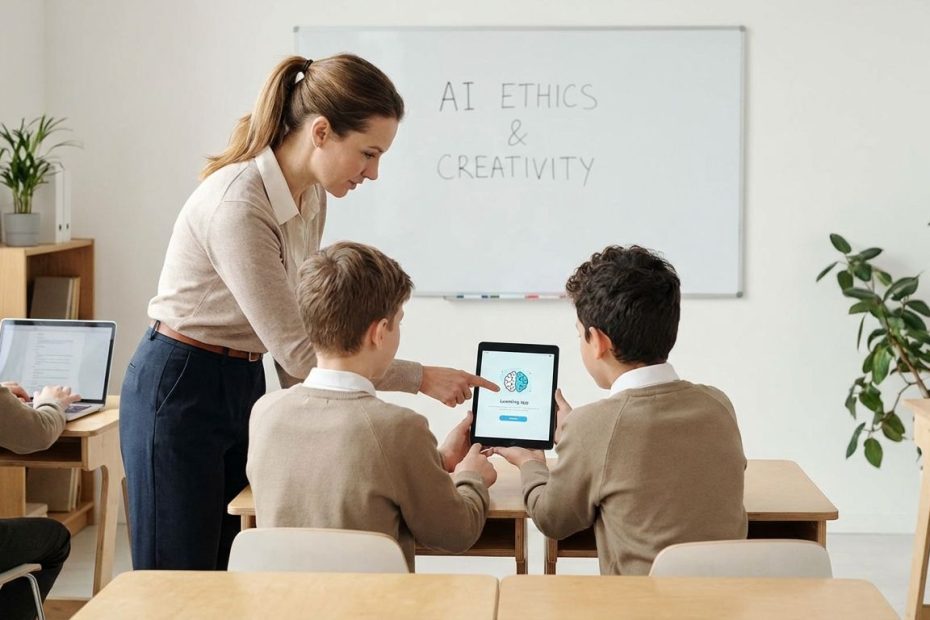
Your role in an artificial intelligence-enhanced learning environment is not smaller. It is sharper, more visible, and more important, because you decide when automation supports learning and when human judgment must lead.
You are no longer limited to delivering content. You are designing learning experiences, protecting thinking time, setting quality standards, and making sure students still receive instruction that is accurate, personal, and worth trusting.
As artificial intelligence tools move into lesson planning, feedback, differentiation, and assessment, your work changes in practical ways. You need a clearer operating model for classroom use, stronger control over assessment design, and a disciplined method for keeping students engaged in real thinking. This article shows what that role looks like now, where schools are seeing value, where trust breaks down, and what you can implement to lead well.
What Is The Teacher’s Role In An Artificial Intelligence-Enhanced Learning Environment?
Your role shifts from primary information source to instructional decision-maker. Students can now reach summaries, explanations, examples, quizzes, and writing support within seconds, but access does not equal learning. You remain the person who sets the objective, chooses the method, checks the quality, and turns activity into progress.
That shift matters because artificial intelligence tools can generate output without understanding your students, your classroom climate, or the developmental level behind a task. A system can produce practice questions or draft feedback, yet it cannot read the room, detect confusion that is still unspoken, or judge whether a student needs challenge, reassurance, redirection, or time. Your professional value grows in the moments where judgment, timing, and relationships determine whether learning sticks.
In practical terms, you become the architect of the learning process. You decide when students should use artificial intelligence for brainstorming, when they should work without it, when to require handwritten notes, when to move learning into discussion, and when to make students defend their reasoning aloud. That design work is not a side duty. It becomes central to effective teaching in classrooms where artificial intelligence is present.
You also become the standard-setter for trust. Students and families need to know what is allowed, what is not allowed, what counts as authentic work, and how feedback is created. If those boundaries are vague, students test them, parents question them, and instructional credibility weakens. In an artificial intelligence-enhanced environment, trust is built through visible teacher judgment, not through invisible automation.
School adoption data reinforces this shift. National reporting and survey work show that teacher use of artificial intelligence is growing, though not evenly, and that school leaders often adopt these tools faster than classroom routines mature. That leaves you carrying the real implementation load: deciding what belongs in daily instruction, what belongs only in planning, and what should stay out of the classroom altogether.
That is why your role is not to compete with artificial intelligence on speed. Your role is to control how speed affects learning quality. You turn generated content into instruction, convenience into structure, and tool access into real academic work.
How Are Teachers Actually Using Artificial Intelligence In Classrooms Right Now?
Most classroom use starts behind the scenes. Teachers are using artificial intelligence to draft lesson materials, generate examples, adjust reading levels, build quizzes, summarize source material, create parent communication, and reduce repetitive preparation work. These uses gain traction because they save time without handing core instruction over to a machine.
That pattern matters. When teachers first adopt a new tool, they usually start where the risk is lower and the time savings are obvious. Planning support, worksheet generation, vocabulary lists, rubric drafting, and simple differentiation tasks fit that need. You can review the output, edit it, align it to standards, and keep full control over what reaches students.
Instructional use is expanding, though it remains uneven across subjects, schools, and teacher comfort levels. Survey data from United States schools shows that artificial intelligence adoption among teachers is real but far from universal, with stronger use in some subject areas than others. Many educators still use these tools only occasionally, which suggests experimentation rather than full integration.
That uneven pattern is easy to understand from inside a school. Tools may be available, but clear policy, practical training, and curriculum alignment often lag behind. A teacher with strong subject knowledge and limited support may still avoid classroom use if the output is inconsistent, the privacy questions are unresolved, or the assignment design has not caught up with the technology.
Another reason use is rising is simple: artificial intelligence is no longer confined to stand-alone chatbot products. It is built into mainstream classroom platforms, productivity suites, presentation tools, and educational software that teachers already use. You may be encountering artificial intelligence features inside tools adopted for unrelated reasons, which makes implementation feel gradual even when the shift is significant.
The strongest use cases remain teacher-facing rather than student-independent. Families and educators tend to be more comfortable when artificial intelligence helps you prepare stronger lessons, adapt materials, and free up time for direct instruction. Resistance rises when the tool appears to replace teaching, replace feedback, or weaken accountability for student effort. That distinction shapes how schools gain buy-in and where classroom trust holds.
Will Artificial Intelligence Replace Teachers Or Make Teachers More Important?
Artificial intelligence will not remove the need for teachers. It increases the value of the parts of teaching that cannot be automated well: judgment, motivation, feedback quality, classroom culture, and assessment integrity.
Students do not need a teacher only to receive information. They need a teacher to make sense of that information, sequence it well, connect it to prior knowledge, catch misconceptions early, and maintain standards when shortcuts become easy. Artificial intelligence can generate a polished explanation in seconds. It cannot tell whether the explanation lands with your students, whether it confuses more than it clarifies, or whether the task attached to it measures anything meaningful.
This is why the teacher’s role becomes more important, not less, as automation expands. The faster a system produces content, the greater the need for someone who can evaluate that content against learning goals. The easier it becomes for students to produce finished-looking work, the more important it becomes for you to verify thought processes and redesign assignments around real understanding.
Current training investments across the education sector point in the same direction. When organizations, school systems, and major technology partners invest in teacher training on artificial intelligence, they are treating teachers as the operating layer that determines whether the tool helps or harms instruction. If replacement were the actual model, large-scale training for classroom professionals would make little sense.
Public reaction also reinforces the point. Students become skeptical when feedback sounds generic, when grading comments miss the substance of their work, or when a teacher seems detached from the assignment. Teachers become skeptical when student writing arrives polished but disconnected from the student’s usual ability or in-class performance. These trust failures do not reduce the need for teachers. They make visible how much schools still depend on teacher judgment.
Your role grows in value wherever the cost of getting it wrong is high. Feedback that shapes confidence, assessments that influence progression, reading choices that affect comprehension, and discussions that build reasoning all require human control. Artificial intelligence can support those moments. It cannot own them without damaging quality.
How Can You Use Artificial Intelligence Without Hurting Student Critical Thinking?
You protect critical thinking by using artificial intelligence as support for the process, not as a substitute for the thinking itself. Students still need to read carefully, take notes, justify choices, compare evidence, revise reasoning, and explain conclusions in their own words. If the tool handles all of that, students may finish tasks but learn less from them.
Recent reporting and research have pushed this issue into the center of classroom discussion. Teachers are reporting concern that students may outsource thinking too quickly, especially when assignments reward polished output more than visible reasoning. At the same time, learning research tied to reading and study behavior suggests that students perform better when active habits like note-taking remain central, with artificial intelligence used alongside those habits rather than instead of them.
That gives you a clear operating rule: preserve friction where learning requires it. Students need moments where they must decide, sort, explain, and defend. Artificial intelligence can help generate starting points, surface counterarguments, simplify source material for access, or provide extra practice. It should not erase the effort required to build comprehension and judgment.
Assignment design does most of the work here. You can require annotated notes, draft checkpoints, oral explanation, in-class writing, source comparison, revision commentary, and short reflections that explain how a conclusion was reached. When students must show their process, artificial intelligence becomes easier to use productively and harder to use as a shortcut that replaces thought.
You also need to teach verification as a routine academic behavior. Students should not treat generated text as settled truth. They should check claims against class materials, identify weak reasoning, spot missing evidence, and correct errors. When you teach students to audit artificial intelligence output, you keep analysis active and strengthen digital literacy at the same time.
Classroom norms matter just as much as task design. If students believe speed is rewarded more than depth, they will use tools to finish faster. If they know they will discuss, defend, revise, and apply what they produce, they are more likely to stay mentally present. Your role is to align the structure of the work with the kind of thinking you want to see.
What Should You Do About Artificial Intelligence Cheating And Unreliable Grading?
You need stronger assessment design, clear use rules, and limits on automation in high-stakes feedback. Artificial intelligence does not just create a cheating problem. It exposes weak assessment habits that were already vulnerable to formulaic responses and low-authenticity work.
Take-home assignments with generic prompts, predictable answer formats, and little process evidence are now easy to complete with external help. That does not mean homework has no value. It means you need to redesign tasks so they reflect your students, your class discussions, and your instructional priorities. Personalized prompts, version history, staged submissions, and short in-class checks make it easier to confirm ownership and understanding.
At the same time, grading requires caution. Students notice when feedback feels generic, vague, repetitive, or disconnected from what they actually wrote. That weakens trust quickly. If students believe their work is being run through automation with little teacher review, they stop seeing feedback as instruction and start seeing it as a transaction.
You can still use artificial intelligence to support feedback workflows. It can help organize rubric language, draft comment banks, surface common error patterns, or suggest ways to differentiate next steps. The line should stay firm around final judgment. You need to review, revise, and personalize comments so the student can see that a real teacher understood the work and responded to the specific choices inside it.
Detection should not become the center of your strategy. Chasing whether a student used a tool on one assignment often burns time and damages classroom climate without solving the larger problem. A better model is to design for authenticity from the start. If students know they must discuss their work, show drafts, reference class-specific material, and complete some tasks live, misuse becomes harder to hide and less attractive to attempt.
Policy clarity also matters. Students need to know when artificial intelligence use is allowed, what kind of use is allowed, how it must be disclosed, and what crosses the line into misrepresentation. Families need the same clarity. When expectations are explicit and consistent, enforcement becomes fairer and instruction becomes easier to defend.
What Skills Do You Need To Lead In An Artificial Intelligence-Powered Classroom?
You do not need to master every tool on the market. You need the ability to evaluate tools quickly, connect them to learning goals, protect student data, and redesign assignments so learning remains visible.
The first skill is artificial intelligence literacy. That means understanding what these systems do well, where they fail, how they generate output, why hallucinations happen, and what kinds of bias or error can appear. Without that baseline, it becomes too easy to overtrust polished responses or adopt features that look useful but weaken learning.
The second skill is prompt judgment. This is not about clever wording for its own sake. It is about asking better instructional questions, setting constraints, specifying reading levels, defining output formats, and knowing when a prompt is too broad to produce useful material. Better prompts save time, but stronger evaluation matters more than the prompt itself.
The third skill is assessment redesign. In many schools, this becomes the most important capability of all. You need to build assignments that capture reasoning, process, and student voice rather than surface-level completion. That includes oral checks, live performance, reflection, source use, revision analysis, and tasks tied directly to classroom interaction.
The fourth skill is privacy and data judgment. Not every tool deserves classroom use. You need to know what information should never be entered, how student work may be stored, whether outputs can be retained for model training, and what district rules apply. If those answers are missing or vague, the tool should not touch sensitive classroom data.
The fifth skill is communication. You need to explain your expectations to students, reassure families without overselling the technology, and help school leaders understand what implementation looks like inside real classrooms. Teachers often become the translators between policy language, product claims, and day-to-day practice.
Professional development has improved, and more teachers are receiving at least some training on artificial intelligence than before. Still, classroom staff often remain more cautious than administrators, which makes sense. You are the one dealing with the output, the confusion, the parent questions, and the grading consequences. Practical support matters more than promotional messaging, and you should evaluate any training by one standard: does it improve teaching decisions you must make tomorrow morning?
How Should Schools Balance Artificial Intelligence Innovation With Trust, Safety, And Human Connection?
Schools need controlled adoption, visible boundaries, and a clear reason for every classroom use. Artificial intelligence should enter instruction where it improves clarity, access, efficiency, or responsiveness. It should stay out of workflows where it weakens trust, blurs accountability, or distances teachers from students.
That balance starts with transparency. Students should know when they are allowed to use artificial intelligence, when teachers are using it in the workflow, and how final decisions are made. Families should understand the school’s position on privacy, grading, tutoring support, and acceptable use. Trust grows when expectations are explicit and visible.
Age matters too. Younger students need tighter limits, stronger modeling, and simpler use cases tied to teacher supervision. Older students may be ready for guided use that includes evaluation, comparison, and disclosure requirements. Schools that ignore age differences usually end up with rules that are too loose for one group and too restrictive for another.
Human connection must remain easy to see. Students should still receive meaningful feedback from a teacher who knows their work. They should still have live discussion, direct questioning, collaborative problem-solving, and moments where effort is recognized. If artificial intelligence use reduces those experiences, the tool is displacing value instead of adding it.
Implementation also needs restraint. New features arrive faster than schools can test them well. A disciplined school does not deploy a tool just because it exists inside a major platform. It checks alignment, usability, privacy terms, teacher readiness, and instructional value. Slow, selective adoption often produces better outcomes than broad rollout without support.
Your role inside that balance is practical and decisive. You are the person who sees whether students are thinking more deeply, becoming more passive, receiving better support, or drifting into dependency. That classroom signal matters more than polished vendor claims. School systems need teacher feedback that is specific, evidence-based, and grounded in student work if they want artificial intelligence use to stay credible.
How Do You Redesign Daily Teaching So Artificial Intelligence Supports Learning Rather Than Distracts From It?
You redesign daily teaching by making the learning process more visible. When artificial intelligence can generate an answer quickly, your instruction needs to emphasize explanation, revision, discussion, and application. Students should not just arrive at an output. They should show how they got there and why their answer holds up.
Start with objectives that are tighter and easier to measure. If the goal of a lesson is vague, artificial intelligence can fill the space with polished but shallow work. If the goal is specific, you can determine where the tool may help and where independent thinking must stay protected. Tight objectives also make feedback faster and more credible.
Move more value into what happens during class. Live questioning, partner explanation, quick writes, note checks, and short oral defenses allow you to monitor thinking in real time. This does not eliminate outside work. It raises the importance of in-class evidence so that learning is not judged only by take-home products.
Build revision into the workflow. A single final submission tells you less than a draft, a conference note, a peer exchange, and a final explanation of what changed. Artificial intelligence can support earlier phases by generating examples, clarifying directions, or helping students organize material. Your design should ensure that the final grade still reflects the student’s own reasoning and refinement.
You should also normalize tool disclosure. If students use artificial intelligence to brainstorm, summarize, or generate practice questions, require them to note how they used it and what they changed. That turns use into something accountable instead of hidden. It also helps you distinguish productive support from overreliance.
Small routine choices matter more than dramatic policy statements. One revised rubric, one stronger discussion protocol, one added draft checkpoint, and one requirement for source-based explanation can improve instructional quality fast. You do not need to rebuild your entire course at once. You need to identify where artificial intelligence creates the most distortion and adjust those points with precision.
What Does Strong Teacher Leadership Look Like As Artificial Intelligence Becomes Normal In Education?
Strong leadership looks calm, specific, and operational. You do not need to perform excitement about every new tool, and you do not need to reject them on principle. You need to show that classroom decisions are tied to learning quality, student accountability, and professional standards.
That starts with consistency. Students should be able to tell what counts as acceptable use in your class, how work will be checked, and why some tasks allow artificial intelligence while others do not. Colleagues should be able to understand the reasoning behind your choices. Families should hear a message focused on learning, trust, and clarity rather than hype.
Leadership also means refusing weak uses, even when they promise convenience. If a tool produces generic feedback, encourages answer-copying, or stores student data in ways your school cannot defend, you should reject it. Professional judgment matters most when the short-term gain is obvious but the instructional cost is hidden.
You also lead by modeling disciplined use. If you use artificial intelligence to draft material, refine it visibly. If you ask students to verify output, show them how verification works. If you want students to disclose tool use, be transparent about how technology supports your own workflow. That kind of consistency builds credibility fast.
The most effective teachers in this environment are not the ones using the greatest number of tools. They are the ones who make better decisions with the tools they choose. They preserve rigor, save time where it makes sense, and keep learning personal enough that students still feel taught rather than processed.
That is the practical future of teaching with artificial intelligence. You stay in control of the instructional model, and the technology earns its place one use case at a time.
What Is The Teacher’s Role In An Artificial Intelligence-Enhanced Learning Environment?
- Design learning, do not just deliver content
- Set rules for responsible artificial intelligence use
- Protect critical thinking and authentic assessment
- Review output, personalize feedback, and keep instruction human
Lead The Classroom, Do Not Let The Tool Lead You
Your value in an artificial intelligence-enhanced learning environment comes from what technology cannot do well: judge quality, build trust, protect thinking, and turn activity into learning that lasts. The most effective use of artificial intelligence in schools happens when you control the conditions, verify the output, and redesign work so students remain mentally engaged. Schools will keep adding tools, and students will keep finding faster ways to produce answers, which makes your instructional judgment more important with every cycle of adoption. If you lead with clear expectations, stronger assessment design, disciplined feedback practices, and visible human presence, artificial intelligence becomes a support system rather than a substitute for teaching. That is how you keep the classroom productive, credible, and worth showing up for.
References
- https://www.edweek.org/technology/more-teachers-are-using-ai-in-their-classrooms-heres-why/2026/01
- https://www.unesco.org/en/digital-education/ai-future-learning/guidance
- https://www.rand.org/content/dam/rand/pubs/research_reports/RRA100/RRA134-25/RAND_RRA134-25.pdf
- https://www.commonsensemedia.org/sites/default/files/research/report/generative-ai-in-k-12-education-white-paper-updated-aug-2024-final-2.pdf
- https://time.com/7301335/ai-education-microsoft-openai-anthropic/
- https://cdn-dynmedia-1.microsoft.com/is/content/microsoftcorp/microsoft/final/en-us/microsoft-product-and-services/microsoft-education/downloadables/AI-and-Reading-Study.pdf
- https://www.axios.com/2025/03/30/teachers-ai-students-critical-thinking
- https://www.aiedu.org/pulse
- https://blog.google/products-and-platforms/products/education/our-life-with-ai-2025/
- https://www.reddit.com/r/ChatGPT/comments/1p2df8z/my_teacher_uses_chatgpt_to_grade_my_assignments/
- https://www.reddit.com/r/Teachers/comments/1kkskcw

Jay Holstine is a Vistage Chair and veteran tech CEO with 20+ years of experience in SaaS and operations. The founder of SigmaFlow and former CEO of Freightflow, he now leads a Dallas–Fort Worth CEO peer group and advises executives on strategy, process improvement, and scalable growth.