
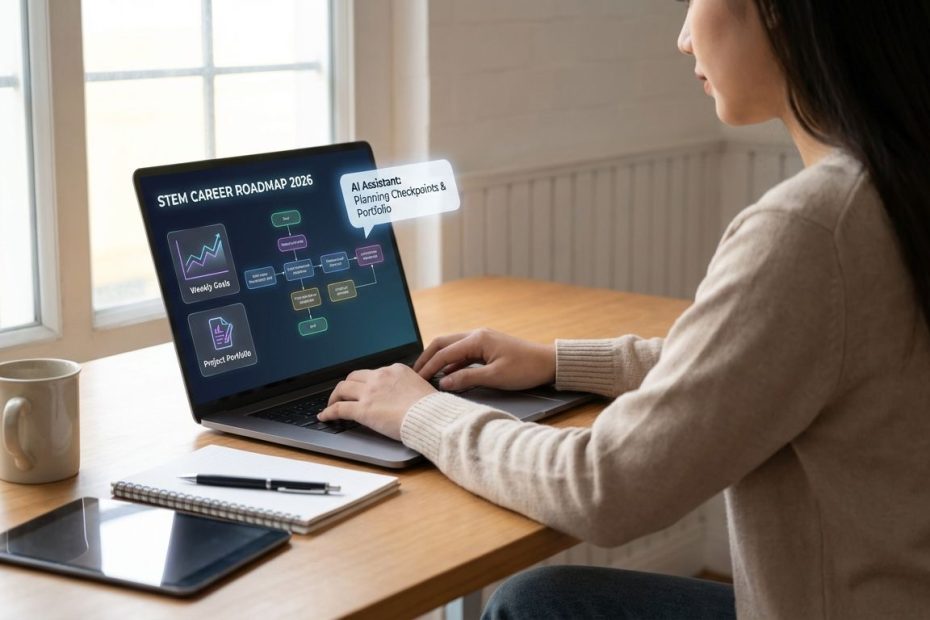
You can prepare for a STEM career faster and with less confusion by using AI as a digital mentor that turns your interests and constraints into a role-specific plan, weekly deliverables, and a portfolio that hiring teams can verify. In 2026, “AI skills” function less like a specialty and more like baseline fluency layered onto software, data, cloud, and security work.
This guide shows how to pick a realistic STEM role, build job-ready skills without tutorial drift, and use AI tools to plan, practice, and ship proof. You’ll also get concrete roadmaps, portfolio patterns, and a clean definition of “AI literacy” that maps to hiring signals right now.
How Do You Use AI As A “Digital Mentor” To Pick The Right STEM Career Path?
Treat the model like a high-output career coach that requires structured inputs and produces auditable outputs. Feed it your constraints in a single message: weekly hours, math comfort, preferred work style (build systems, analyze data, defend systems), current skills, and a deadline. Ask for three role matches, a skills gap map for each, and a 30/60/90-day plan with weekly checkpoints.
Keep the interaction performance-driven by forcing specificity. Require the AI to output deliverables that can be checked by a recruiter: a GitHub repo, a deployed demo, a case study, a short technical write-up, and a list of interview questions mapped to the projects. When the output gets vague, push it back into measurable terms: “define done,” “define acceptance criteria,” “define tests,” “define what goes into the README.”
Use AI for decisions, then validate decisions with market signals. In late 2025 reporting based on job-posting analysis, employers were already expecting basic prompt skills even for entry-level IT roles, with AI-related restructuring impacting software engineering, QA, product, and project roles. The same analysis tied hiring focus to cybersecurity, data analysis, and AI implementation work.
What STEM Skills Are Employers Actually Asking For In 2026 (Not Just Hype)?
Hiring signals point to a blended skill profile: domain fundamentals plus AI-enabled execution. Late 2025 job-posting analysis highlighted fast growth in AI requirements and also called out Python, algorithms, CI/CD, and cloud skills as rising signals in postings year over year. That combination matters because it matches how teams build now: software delivery pipelines, cloud platforms, and data-driven features, with AI embedded into tooling and products.
AI literacy is also turning into a baseline filter. One industry report aimed at job seekers stated that 50% of U.S. tech job postings required AI skills as of September 2025, up from 47% in August 2025, and representing a 98% jump compared to September 2024. That is not “everyone needs to become an ML engineer,” it is “you need enough AI fluency to operate in modern teams and job descriptions.”
Translate those signals into practical bundles you can train for and prove quickly. For entry-level targeting, hiring teams evaluate you on whether you can ship, debug, and communicate. A clean bundle looks like: one programming language, one data skill, one delivery skill, one AI workflow skill. That mix holds across software engineering, analytics, cloud, and security roles.
Can You Get A STEM Job In 6 Months, And What Should Your Roadmap Look Like?
A six-month plan works when you narrow fast, produce proof weekly, and stop collecting courses. The market still rewards people who can deliver, explain tradeoffs, and show working artifacts. That means your plan needs deadlines, project scope limits, and public outputs, not a long list of resources.
Build your roadmap around three hiring checkpoints: (1) baseline competence, (2) credible portfolio, (3) interview readiness. Baseline competence means you can complete tasks without constant hand-holding: build a small service, write SQL queries correctly, deploy a container, or complete a security lab write-up. A credible portfolio means your work runs, has tests or validation, and includes a short explanation of decisions. Interview readiness means you can narrate your work, troubleshoot live, and answer fundamentals.
Make AI your execution multiplier, not your substitute. Use it to draft a weekly plan, generate practice problems, review code, and create test cases. Keep accountability on your side by writing the README, recording demos, and adding a “verification” section that explains how outputs were checked. Hiring teams care less about whether AI was used and more about whether you can control quality under real constraints.
What Does “AI Literacy” Mean For Students And Early-Career STEM Candidates?
AI literacy means you can use AI tools to produce work safely and reliably, then verify and communicate the output. In practical terms, you can turn a vague ask into a prompt, iterate toward a testable deliverable, and catch errors before they become production incidents. That skill shows up in how you build, not in how many model names you can list.
Define it with behaviors you can demonstrate during screening. You can write prompts that yield structured outputs, then validate with unit tests, spot checks, citations when appropriate, and sanity checks against known constraints. You can also protect sensitive information by controlling what goes into prompts and what stays local. You can explain limitations, edge cases, and what would fail in the real world.
Hiring signals already reflect this shift toward “AI as standard tooling.” A job-market report for candidates framed AI skills as baseline requirements across a large share of postings, and the same report emphasized the rapid rise of these requirements across 2024–2025.
Which STEM Path Should You Choose: Data, Cybersecurity, Cloud/DevOps, Or Software Engineering?
Pick the path where you can generate proof fastest and tolerate the daily work. You are not choosing a lifetime identity, you are choosing the next credible role that lets you compound skills. Your best indicator is whether you can ship a portfolio piece in 14 days and still want to improve it.
Data and analytics fits people who like clarity, measurement, and business-facing storytelling. You win by building dashboards, analyses, and short case studies that answer specific questions. Cloud/DevOps fits people who like systems, reliability, automation, and repeatable deployments. You win by demonstrating CI/CD, containerization, and infrastructure that a reviewer can run. Cybersecurity fits people who like adversarial thinking and defensive controls. You win by producing lab write-ups, threat models, and evidence of methodical testing. Software engineering fits people who like building product features and managing complexity. You win by shipping working apps with clean code, tests, and thoughtful tradeoffs.
Market signals support demand across these areas, with job-posting analysis highlighting AI’s rise alongside skills like Python, algorithms, CI/CD, and cloud platforms as growing mentions. That is a strong hint that “role plus modern tooling” beats “single-topic study.”
How Do You Build A Portfolio That Proves You Can Work With AI Without Faking Expertise?
Build projects where AI is one component in a system you control. A hiring manager trusts you when your project shows boundaries: what the model does, what your code does, how you validate outputs, and what breaks. That approach also protects you in interviews because you can defend design decisions and quality checks.
Use a repeatable portfolio template: problem statement, requirements, architecture diagram, setup steps, tests, evaluation method, and limitations. Add a short “AI Usage” section that states exactly how AI contributed: prompt generation, code review, test creation, documentation drafting, or data labeling guidance. Then add the verification layer: unit tests, evaluation set, regression checks, and manual review steps.
Tie your portfolio to the hiring signals that keep repeating in postings. If AI skills show up in half of postings, and CI/CD and cloud skills are also growing signals, then a strong portfolio pairs an AI-enabled feature with a deployment pipeline. One clean example: a small service that summarizes support tickets, with automated tests, a container build, and a simple deployment workflow. That reads like a real-world project rather than a demo script.
How Do You Turn “Personalized Learning” Into A Weekly System That Keeps You On Track?
A digital mentor only helps if it drives a cadence. Set a weekly operating rhythm: one learning objective, one build objective, one validation objective, one communication objective. Learning covers a narrow concept, build produces a feature, validation proves correctness, communication produces a short write-up or demo.
Use AI to generate weekly tasks, then lock them into a calendar and track them like deliverables. Ask for a checklist with time estimates and clear acceptance criteria. Keep a visible scoreboard: commits, shipped features, test coverage movement, number of solved problems, number of mock interviews completed. The model can also generate interview questions aligned to what you built, which prevents studying irrelevant material.
Budget time for skill refresh because skills are changing faster in AI-exposed roles, according to reporting that cited research on accelerated skill change in AI-linked jobs. That makes a weekly rhythm even more important: you need a system that absorbs change without resetting your plan every time a new tool trend appears.
How Do You Prepare For A STEM Career With A Digital Mentor?
- Pick 1 role, set a 6-month plan
- Ship 3 projects, publish proof weekly
- Use AI for planning, practice, reviews
- Validate with tests, demos, READMEs
Build Your Digital Mentor, Then Ship Your Way Into The Role
A personalized STEM plan wins when it produces public proof on a schedule and aligns with the skills hiring signals reward right now. Lock onto one role, build a weekly system, and treat AI like an accelerator for planning, practice, and quality control. Keep deliverables concrete: repos, demos, write-ups, and tests that show real competence. When the market shifts, adjust the weekly tasks, not the goalpost. That is how you stay employable in 2026 without burning cycles on noise.

Jay Holstine is a Vistage Chair and veteran tech CEO with 20+ years of experience in SaaS and operations. The founder of SigmaFlow and former CEO of Freightflow, he now leads a Dallas–Fort Worth CEO peer group and advises executives on strategy, process improvement, and scalable growth.